Development & Evaluation of a Novel Aligner-Attachment System for Enhanced Bodily Tooth Movement
Abstract
Clear aligner therapy (CAT) is widely accepted for its aesthetics and patient comfort, but predictable bodily tooth movement (translation) for significant mesialization/distalization remains limited due to aligner flexure ("bowing effect"). We propose a novel, composite resin, long horizontal buccal attachment that mimics an orthodontic archwire plus a three-sided reinforced aligner channel. This system aims to generate appropriate moment-to-force ratios to achieve translation rather than tipping. This proposal describes design, in-vitro biomechanics, and a pilot clinical study to validate the system.
1. Problem Statement
- Aligner flexibility causes the bowing effect resulting in tipping rather than bodily translation.
- Current attachments are limited: predictable mesial/distal bodily movement is clinically reliable up to ~3.2 mm; beyond this predictability drops.
- There is clinical demand to reliably perform larger translational movements and extraction-space closures without TADs where possible.
2. Proposed Solution (Core Innovation)
Core Features
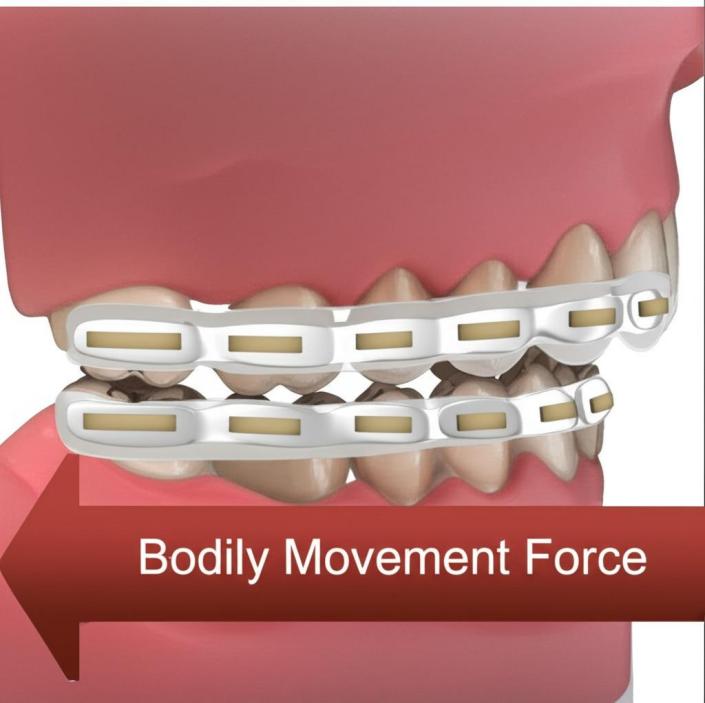
- Long, Horizontal Buccal Attachment: A continuous elongated attachment spanning the mesiodistal width of the clinical crown to be translated. Fabricated from rigid composite resin, with optimized surface texture to improve mechanical interlock with the aligner.
- Three-Sided Reinforced Aligner Channel: Aligner is locally thickened to create a snug, tube-like channel that wraps the attachment from three sides, preventing bowing and providing guided sliding during translation.
- Lingual Counter-Attachments: Minimal lingual attachments placed to deliver counter-moments and prevent unwanted rotations — enabling controlled moment-to-force ratios for bodily movement.
Key Mechanism: The extended length of the buccal attachment plus the three-sided aligner tube enables translation by creating a rigid interface that converts aligner loads into consistent force vectors across crown and root—reducing tipping moments.
3. System Diagram & Workflow
Overview of design → in-vitro evaluation → pilot clinical validation workflow.
Design & CAD
Iterative CAD & CAM prototyping of attachment geometries and aligner channels.
Material Selection
Evaluation of aligner materials and composite resin for optimal mechanical properties.
In-Vitro Testing
FEA simulations and force measurement to quantify moment-to-force ratios.
Prototype Iteration
Optimization of attachment geometry based on biomechanical testing results.
Pilot Clinical Study
Patient monitoring with intraoral scans to validate bodily movement outcomes.
4. Interactive Biomechanics Demonstration
Compare conventional aligner tipping vs. our novel system's bodily translation. The 3D visualization shows how the long horizontal buccal attachment prevents the crown from tipping independently of the root.
Interactive 3D Viewer: Use your mouse to rotate and zoom. The demonstration shows conventional tipping (left) versus bodily translation (right) with the novel attachment system.
3D viewer requires WebGL support
Your browser doesn't support WebGL or it's disabled. Showing static preview:
Left: Conventional aligner showing tipping movement (crown moves more than root)
Right: Novel system showing bodily translation (crown and root move together)
5. Research Methodology (Phases)
Phase 1 — Design & Fabrication
- CAD/CAM design of multiple buccal attachment geometries and aligner-channel geometries.
- 3D-printing/printing jigs and prototype composite attachments; optimize surface texture for mechanical interlock.
- Selection/evaluation of aligner materials with local reinforcement (thicker regions) to create a stiff channel while keeping global flexibility.
Phase 2 — In-Vitro Biomechanical Testing
- Typodont models and simulated periodontal ligament to measure crown/root movement under controlled displacements.
- Finite Element Analysis (FEA) comparing stress distribution and predicted tooth movement (proposed vs. conventional).
- Force/moment measurement rigs to quantify moment-to-force ratios and degree of tipping vs. translation.
Phase 3 — Pilot Clinical Study
- Recruit 12–20 patients requiring mesialization/distalization (IRB approval & informed consent).
- Deliver prototype aligner-attachment system; monitor progress via intraoral scans (every 4–6 weeks) and cephalometric analysis.
- Primary outcomes: amount of bodily translation vs. tipping, treatment time, patient comfort. Secondary: need for auxiliaries/TADs and any adverse events.
6. Expected Outcomes, Timeline & Budget Estimate
Primary Outcomes
- Objective increase in translational:tipping ratio
- Reproducible M/F ratio suitable for clinical translation
- Protocol for attachment placement and manufacturing
Timeline (22 Months)
- Months 0–4: Design & Material Testing
- Months 4–10: In-Vitro Testing
- Months 10–22: Pilot Clinical Study
Budget Estimate
- Prototyping: €12,000
- Lab testing: €18,000
- Clinical pilot: €40,000
- Contingency: €10,000
- Total: €80,000
7. Ethics, Risk Management & Dissemination
Ethical approval will be sought from the institutional review board. The attachments use approved dental composite materials; however, risk assessments for debonding, soft-tissue interaction, and patient comfort will be included in the ethics submission. If pilot results are positive, we will pursue larger multi-centre trials and peer-reviewed publication.
Key Considerations
- Patient safety monitoring & stop-criteria (e.g., repeated attachment failures, soft tissue irritation).
- Data management plan for scan images and patient identifiers (GDPR-compliant storage and anonymization).
- Planned outputs: 2 peer-reviewed articles (biomechanics + clinical), conference presentations, open CAD design protocols for research use.
8. Conclusion
This proposal introduces a pragmatic but novel biomechanical solution to a persistent limitation of clear aligner therapy. The proposed long horizontal buccal attachment combined with a reinforced aligner channel is designed to produce clinically meaningful bodily movement by creating a guided, stiff interface that manages moment-to-force and prevents bowing. We welcome collaboration with your department to refine the design and execute the evaluation phases.
For further discussion or to request full CV:
Dr. Rahul Joshi
drrahuljoshi01@gmail.com |
+31 6 1949 1023